
Talking Torah - Whose Version Prevails?
In Parshat Balak, Balaam gets an extreme makeover

In 1967, an excavation at Deir Alla, Jordan discovered a series of underground chambers buried in an earthquake around 800 B.C.E. The contents of the chambers suggested it was a ritual site. One chamber contained fragments of a plaster wall that had collapsed, on which there had been inscribed words in black and red ink. Piecing the fragments together, scholars were able to assemble part of a book celebrating one “Bal'am, son of Be'or,” a "seer of the gods." He must have been a religious figure of some renown if his story was worth displaying on the wall of a site of worship.1 Bal’am foils a plot by the gods to sew up the heavens and plunge the world into darkness. The text references a range of local gods, including Ashtar and Shegur, but also “Shaddain” and “Elohin”, the latter names familiar to us from the Torah. The fragments of the plaster wall were well-worn, apparently dating from many years before the earthquake brought them down. Here is a picture of the assembled pieces:
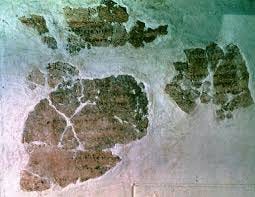
It seems clear that the “Bal’am” celebrated by the Deir Alla inscriptions is the Balaam of this week’s parsha, Balak.
**********************
In the parsha, Balak is king of the Moabites, one of the weaker kingdoms in the Transjordan. He watches as the Israelites crush the mightiest nations in the area. In desperation, he consults with the Midianites (who know Moses from his years in exile in Midian), on how to respond to the Israelite threat. They advise him that Moses uses words as his weapon, so Balak must respond in kind. So he reaches out to Balaam, son of Beor, a man with the power to wield words to bless, and to curse.
Balak sends a delegation of Moabite dignitaries to Balaam to recruit him to curse the Israelites. Balaam says he has to consult YHWH and asks them to stay the night. God appears to him and tells him that he may not curse the Israelites for they are blessed. So the next morning Balaam informs the delegation that YHWH has forbid him to go. Upon hearing of Balaam’s refusal, Balak sends a second delegation, larger and more important than the first, offering great “respect” if he will curse the Israelites. Balaam reframes this as an offer of money and says he will consult “his god YHWH” again that night. This time, God allows Balaam to go but he must perform only as commanded.
Balaam saddles his ass and sets out on his mission. God is angry about it2 and sends an angel to block Balaam’s path. The ass sees the angel and refuses to budge. Balaam cannot see the angel and beats the ass repeatedly. YHWH opens the donkey’s mouth to protest. Then God opens Balaam’s eyes and he sees the angel blocking the way. Balaam tells the angel that he will go back home. The angel tells him to go forward but warns him that he must say only the words given to him.
Balaam takes the Balak and the Moabites to various hilltops and at each he sets up seven altars, sacrifices oxen and sheep, and pronounces words of blessing that YHWH has put in his mouth. These include the famous words, “How goodly are thy tents O Jacob,” that have been incorporated into the daily morning prayer. Balak, enraged, dismisses Balaam and refuses to pay him. Balaam delivers one last prophecy about Israel’s future triumphs before departing.
As a final footnote, a few chapters later, the Israelites take revenge on the Midianites for allying themselves against Israel by slaughtering them, along with Balaam.3
***************************
In addition to the Book of Numbers, Balaam is referenced several times in the Talmud and other Rabbinic sources. Views are mixed. One source says that he had true prophetic powers, on par with Moses and perhaps greater.4 But other sources disparage him.5
But the real battle of narratives about Balaam is between the Bal’am of the Deir Alla inscription and the Balaam of our parsha. In the former, Bal’am is a revered prophet. He communes with the many gods of the region and battles to save the world from darkness. But for the authors of the Torah, Bal’am had a major problem - he was a polytheist.
So the Torah’s narrative presents a very different view of this prophet. He is portrayed as a mercenary, willing to curse or bless for the highest bidder. Although he says whether he will go is God’s choice, he pushes past God’s first refusal to get the answer he wants. He mounts a lumbering donkey. He possesses less vision than the ass he rides. But most importantly, the parsha converts Bal’am to monotheism. Balaam consults YHWH to see if he can go on his mission and proclaims he must follow the command of YHWH.
The Balaam episode in Numbers is placed right after the Israelites defeat the mighty kingdoms of Amor and Bashan. The story echoes this military victory with a spiritual conquest - out of the many gods that the great non-Israelite prophet, Bal’am worshipped, YHWH reigns supreme. Balaam blesses the Israelites with words put in his mouth by YHWH. In the end he is murdered for siding against Israel.
And so an ancient fable is repurposed to celebrate the one true God.
*****************************
The chance discovery some 50 years ago of the Deir Alla inscription gives us a remarkable window into the battle for the narrative of Balaam. As Judaism has survived, so has the Torah’s version of this prophet, becoming the last word on the subject.
But in another twist, it is perhaps Balaam who has the last word. In his initial “blessing”, Balaam surveys the Israelite encampment from a hilltop, and declares:
There is a people that dwells apart.
Looking at the broad sweep of history, and both the distinction and the suffering that have accompanied our “apartness,” we might conclude that truer words have never been spoken.
Shavuah tov,
RichThe commentators argue about God’s quick about face here; a discussion for another day.
Numbers 31:8.
Bava Batra 15b lists Balaam as one of the seven great non-Israelite prophets.
See Bamidbar Rabbah 14:20 for a vigorous debate about Balaam.